As artificial intelligence (AI) races ahead faster than governments can regulate it, the Vatican is stepping deeper into the global debate around the technology and its societal impact.
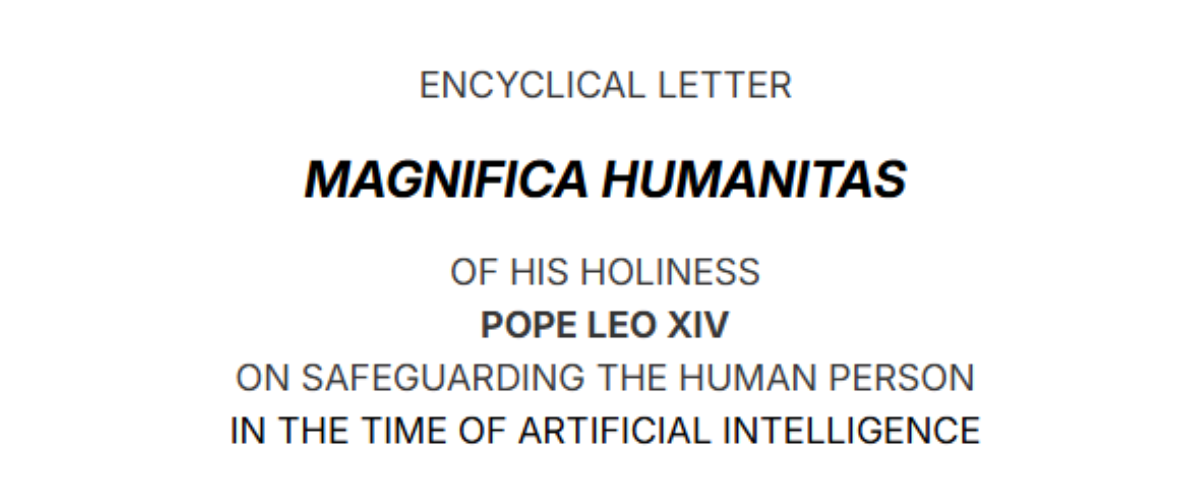
Pope Leo XIV, in his first major teaching document as Pope, Magnifica Humanitas, publicly released on May 25, warned that humanity is at a crossroads. The Holy See Press Office said the encyclical focuses on “safeguarding the human person in the time of artificial intelligence.”
“Humanity, created by God in all its grandeur, is today facing a pivotal choice: either to construct a new Tower of Babel or to build the city in which God and humanity dwell together,” Pope Leo XIV writes in the document.
In a post on X , Leo XIV shared the release of the encyclical and reiterated its warning about humanity’s technological future.
Humanity, created by God in all its grandeur, is today facing a pivotal choice: either to construct a new Tower of Babel or to build the city in which God and humanity dwell together. In Jesus Christ, this humanity in its grandeur becomes the Way, the Truth and the Life, opening…
— Pope Leo XIV (@Pontifex) May 25, 2026
The encyclical was signed at the Vatican on May 15, exactly 135 years after Pope Leo XIII signed Rerum Novarum, the landmark 1891 encyclical addressing workers’ rights during the industrial revolution. The anniversary links the document to the Church’s earlier engagement with industrial-era economic and labor issues.
The encyclical references issues including surveillance, autonomous warfare, economic inequality and the concentration of technological power.
The Pope also used the document to urge governments and technology companies to ensure artificial intelligence serves humanity rather than concentrating power in the hands of a small number of actors.
The release follows the Vatican’s approval earlier this month of an Inter-Dicasterial Commission on AI
The Inter-Dicasterial Commission aims to bring together departments responsible for doctrine, communication, culture and human development and is expected to help coordinate Vatican AI policy and study the long-term societal impact of AI systems.
The commission includes representatives from the Dicastery for Promoting Integral Human Development, the Dicastery for the Doctrine of the Faith, the Dicastery for Culture and Education, the Dicastery for Communication, the Pontifical Academy for Life, the Pontifical Academy of Sciences and the Pontifical Academy of Social Sciences.
Christopher Olah, Anthropic co-founder and head of research on AI interpretability, also participated in the Vatican presentation panel alongside Church officials and academics.
AI FrontPage previously reported that Olah would join the Vatican presentation for the release of Magnifica Humanitas.
Also Read: Vatican Sets Up AI Commission Approved by Pope Leo XIV