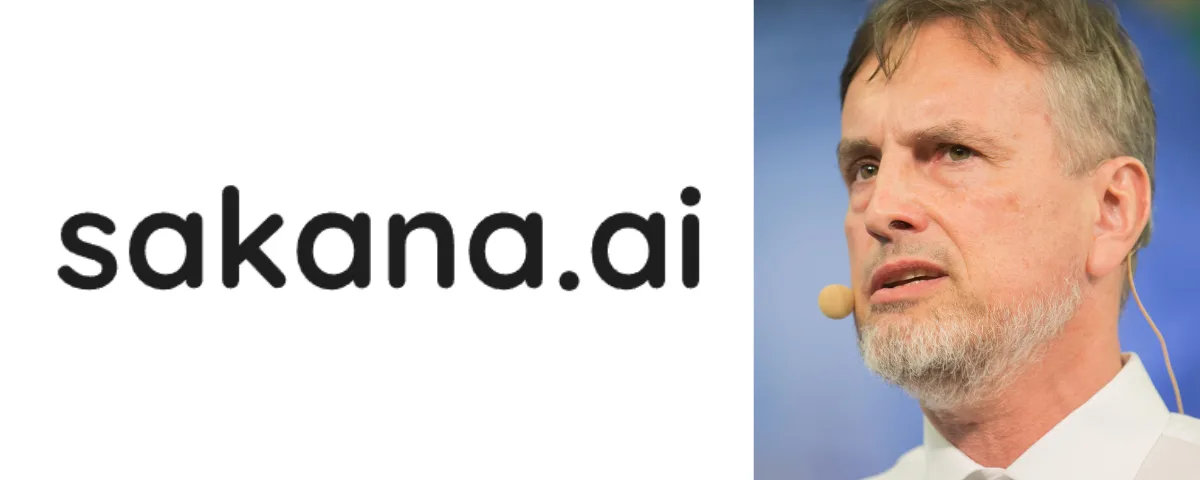
German computer scientist Jürgen Schmidhuber, known for his pioneering work in deep learning and neural-network research, has joined Japan-based Frontier AI lab Sakana AI as chief scientific advisor, where he will help guide the lab’s newly established Recursive Self-Improvement (RSI) Lab.
In a blogpost, Sakana AI announced the appointment on September 24, saying Schmidhuber will continue his existing positions while travelling regularly to Tokyo to work with the team. His research will contribute to Sakana AI’s efforts around recursive self-improvement, world models and autonomous AI systems.
“The next era of artificial intelligence will move beyond digital interfaces and directly into the physical world. To lead this paradigm shift, Sakana AI is incredibly proud to announce that Jürgen Schmidhuber , universally recognized as the father of modern AI, is officially joining Sakana AI as Chief Scientific Advisor, alongside his current positions, and will be involved in our Recursive Self-Improvement (RSI) Lab,” announced Sakana AI.
Jürgen is best known for co-developing Long Short-Term Memory (LSTM) with Sepp Hochreiter in 1997, a recurrent neural-network architecture designed to preserve information over long sequences and overcome the vanishing-gradient problem. LSTM later became important in speech recognition, machine translation, handwriting recognition and other sequential AI systems.
Jürgen has also worked extensively on self-supervised learning, meta-learning (“learning to learn”), artificial curiosity, generative models and neural-network compression. His research group explored systems that learn useful representations by predicting their environments and set their own learning objectives.
Jürgen Schmidhuber氏、Chief Scientific AdvisorとしてSakana AIに参画https://t.co/KhRZXvWyAU
Sakana AIは、現代AIの父として世界的に知られるJürgen Schmidhuber(ユルゲン・シュミットフーバー)氏が、現職との兼任でChief Scientific AdvisorとしてSakana AIに参画し、当社のRSI Labに携わる… https://t.co/GZ9wCcXXRZ
— Sakana AI (@SakanaAILabs) September 24, 2026
“It would be no exaggeration to say that Schmidhuber’s research forms the very foundation of today’s AI. Since his 1987 doctoral thesis exploring the potential of “machines that learn how to learn,” he has pioneered the path toward recursive self-improvement (RSI). In 1990, he proposed the concept of “world models,” in which AI simulates its environment internally before taking action. The 2018 paper “World Models,” co-authored with our CEO David Ha, was a key catalyst in bringing this idea to wide recognition,” added Sakana AI,
Sakana AI also highlighted the influence of Japanese researchers including Kunihiko Fukushima, whose 1979 Neocognitron was an early convolutional neural-network architecture, and Shun-ichi Amari, whose work made major contributions to the mathematical theory of neural networks.
Also Read: Japan Offers ¥600 Million Prize for AI Solutions to Essential Worker Shortage