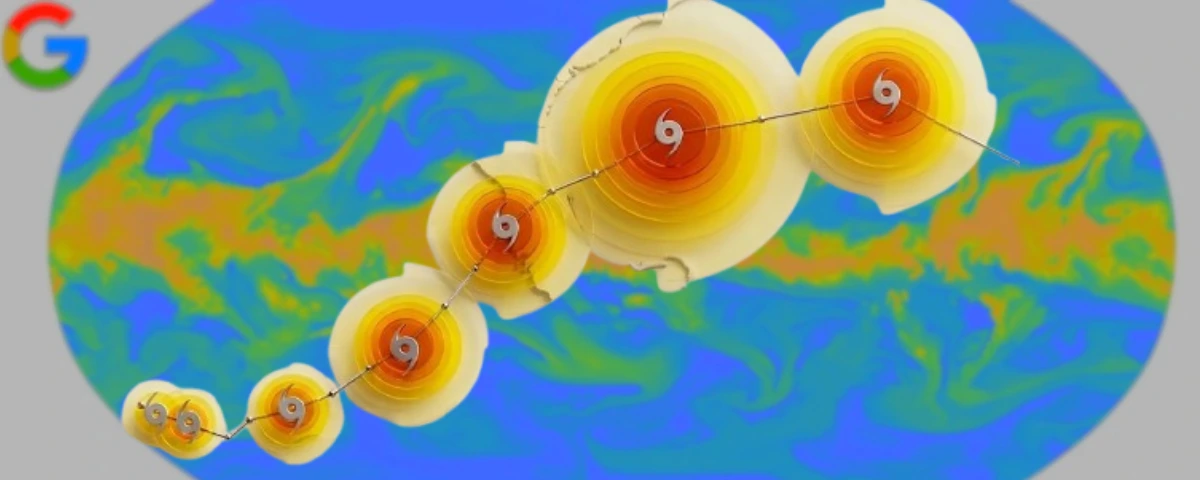
Google DeepMind and Google Research have expanded their WeatherNext family of AI weather models with WeatherNext Cyclones, a system designed specifically for tropical cyclone forecasting.
The model predicts a cyclone’s track, intensity and wind structure. Google says its three-day forecasts are as accurate as what prior models could provide for the next two days, giving forecasters an extra day’s worth of predictive accuracy.
WeatherNext Cyclones combines global weather dynamics with historical cyclone observations in a single AI model, allowing it to forecast the track, intensity and wind structure of tropical cyclones.
The system can generate 1,000 possible scenarios for each cyclone, up from 50 predictions previously. According to he company, the larger ensemble can capture rare but consequential scenarios, including rapid intensification.
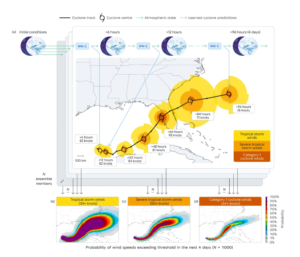
Google said the model had a real-world application during the 2025 hurricane season, when it helped the National Hurricane Center forecast Hurricane Melissa’s rapid intensification and landfall in Jamaica, giving teams on the ground additional time to prepare.
Google is also releasing WeatherNext Cyclones alongside WeatherNext 2. It is also releasing WeatherNext 2-mini, a compact version of the model that can run on a single TPU.
Introduced in November 2025, WeatherNext 2 was Google’s broader weather forecasting model, designed to generate hundreds of possible weather outcomes with predictions at resolutions down to one hour and forecasts extending up to 15 days.
Google is open-sourcing the code and model weights for WeatherNext 2 and WeatherNext Cyclones, making them freely available for academic research, operational forecasting and the development of more specialized and localized models.
Also Read: ‘Symphony, Not Solo’: China Offers the World a Glimpse of Its AI Might at WAIC 2026