
Jev AI, TypeSafe AI’s first “System One” model, has quickly risen the charts to become the fastest-adopted AI model in AI Gateway history, reaching 35% of paid teams in its first 14 days of its launch, according to a latest report by Vercel.
The AI Gateway Production Index — October 2026 by Vercel states that not only was Jev AI the fastest adopted model, it also received the most requests of any model in September despite its public launch only on September 21. An AI gateway is a specialized middleware platform that act as bridge between AI systems and end-user applications, centralizing the deployment and governance of AI models.
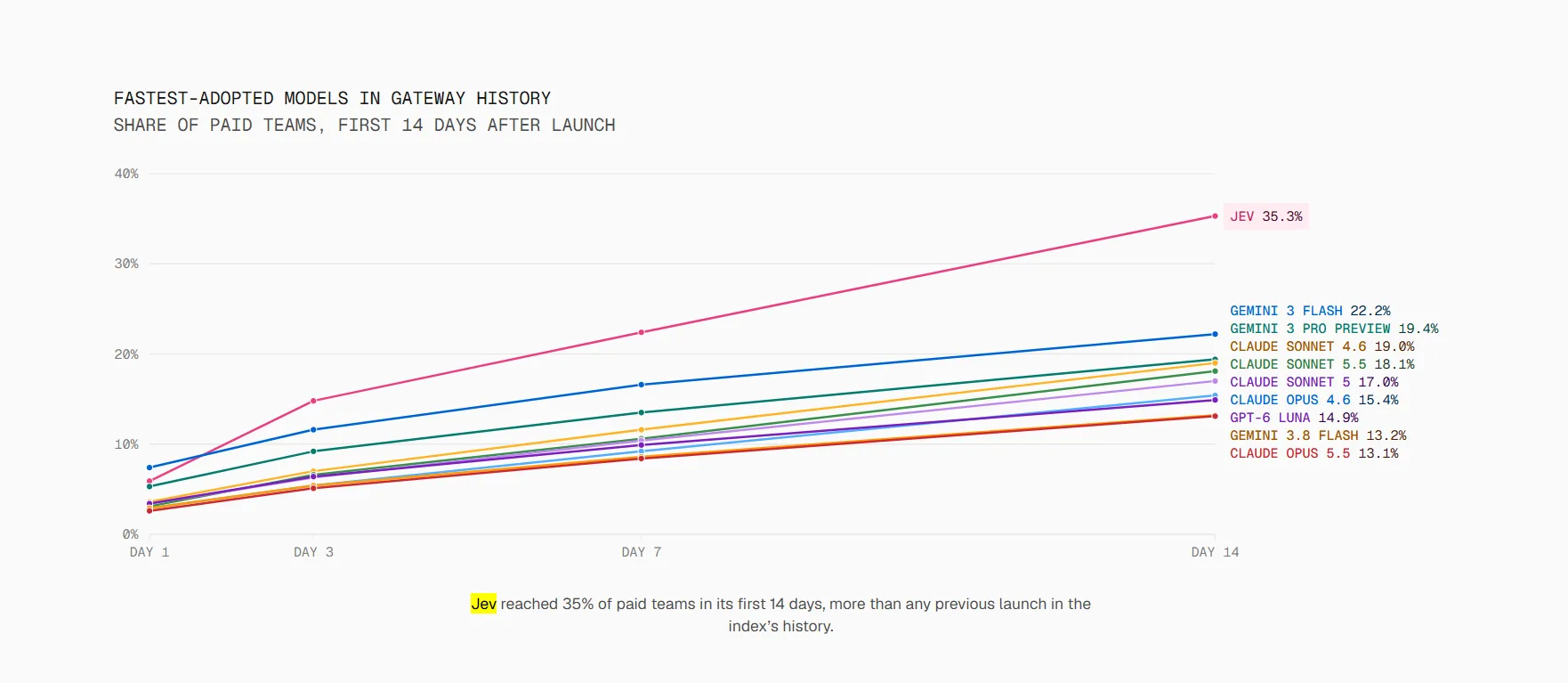
The artificial intelligence index report also stated that of the teams that tried Jev in week one, 55.6% returned in week two, the fifth-highest retention rate.
“Jev is a decision model. Compared with typical language-model requests, a Jev request is faster, cheaper and uses a fraction of the tokens. So although its adoption was fast and broad, it accounted for just 1% of the month’s tokens and 0.15% of spend. In September, Jev quickly became a popular model for production while remaining a tiny part of the inference bill,” read an excerpt from Vercel report.
2. Jev became AI Gateway’s fastest-adopted model ever, and September’s most-requested model. https://t.co/0we0qHBFiF
— Vercel (@vercel) October 15, 2026
In their September full scorecard, Vercel has ranked Jev at 6th position below Claude Sonnet 5.5 , Gemini 3.8 Flash, Claude Opus 5.5, GPT-6 Luna and DeepSeek-V4.1-Flash on the parameters of reach, spend share and retention.
Jev, a decision-based AI model by TypeSafe AI Labs, is unlike conventional LLMs as it does not generate free-form text, instead, when developers send it context and short, typed questions, it returns probabilities and confidence scores, allowing software to use jev engineering for coding agents directly.
TypeSafe AI claims Jev can return decisions in 70 to 500 milliseconds and costs $0.042 per million input tokens, while output tokens remain free. The AI model uses parallel sampling and a new training method RLCD to take unstructured information and return decisions with probabilities and confidence scores.
When it comes to top SAAS vendors, TypeSafe AI also reported breakout growth compared to its size in the first week of October according to a report by Ramp Economics Lab.
TypeSafe AI, a San Francisco based AI Lab, announced its exit from stealth mode through its co-founder Diogo Almeida, former OpenAI researcher, on September 15 with the launch of Jev AI model and launched it for public on September 21. In barely two days after its launch, TypeSafe AI suspended new registrations for Jev after witnessing a surge in demand. Registrations were reinstated later.
Recently, TypeSafe AI launched Jev 1.14 alias Jev Preview, an upgraded version of their flagship model that allows users to upload images in their queries and introduced ‘Box’ System One Question Type and longer context up to 262K tokens.
Also Read: TypeSafe AI Launches Jev 1.14 with Image Request, Box Type, Longer Context and ‘Danger Zone Warning’