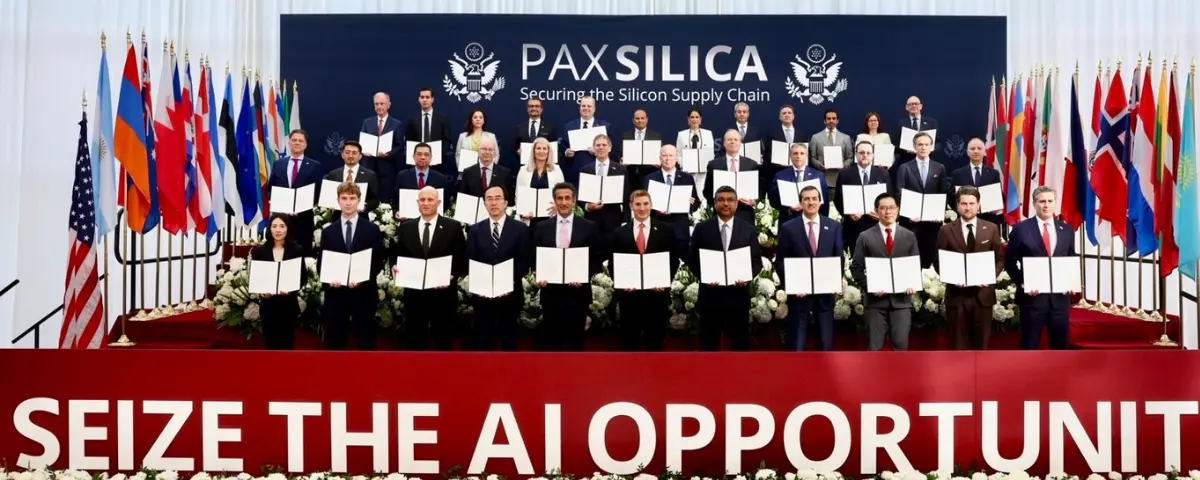
As many as 35 nations signed the ‘Declaration on AI Opportunity’ under the U.S. led Pax Silica to secure supply chains for semi-conductors, AI and rare earth elements on Thursday with the inclusion of 9 new nations, under the non-binding initiative.
The declaration, signed at a Pax Silica Summit event organized by U.S. Under Secretary of State Jacob Helberg at Washington D.C., saw key signatories of Pax Silica, representatives from affiliate economies and senior executives from leading companies attend the two day summit.
The nine new parties to Pax Silica are Argentina, Germany, Chile Costa Rica, Greece, Netherlands, Kazakhstan, Panama and European Union.
Today, 35 nations signed the Declaration on AI Opportunity, aligning behind a PRO-GROWTH, PRO-INNOVATION regulatory approach for the AI era. A commitment to trusted supply chains, to mobilizing the private sector, and the infrastructure that will power the next century….Together, we aspire to build an AI future that serves our peoples, strengthens our economies, and empowers entrepreneurship, innovation, and the rule of law,” said U.S. Under Secretary of State Jacob Helberg.
Today, 35 nations signed the Joint Statement on AI Opportunity, aligning behind a PRO-GROWTH, PRO-INNOVATION regulatory approach for the AI era. A commitment to trusted supply chains, to mobilizing the private sector, and the infrastructure that will power the next century.
The… pic.twitter.com/1yVNSr3C0Y
— Under Secretary of State Jacob S. Helberg (@UnderSecE) June 25, 2026
According to the State Department, the Pax Silica initiative is designed as an overall platform to establish trusted technology partnerships by coordinating investments and speeding up development of strategic areas, such as critical minerals, energy systems, semiconductors, and advanced computing infrastructure from allied countries.
Officials suggest that the initiative has two main goals: to decrease strategic dependencies while encouraging long-term, market-driven innovation among partner economies.
What is Pax Silica Declaration on AI Opportunity?
According to details provided by the U.S. State Department, the Pax Silica Declaration on AI Opportunity unveils a “shared vision to deepen economic partnerships through shared efforts on investment security practices, infrastructure and incentives.”
#WATCH | Washington, DC (US): On the Summit for Pax Silica partner economies, S Krishnan, Secretary of the Ministry of Electronics and Information Technology (MeitY) says, “I think the important element is the way that different countries in the world will come together to build… pic.twitter.com/UAsyd7X27J
— ANI (@ANI) June 25, 2026
“We encourage efforts to partner on strategic stacks of the global technology supply chain, including, but not limited to, software applications and platforms, frontier foundation models, information connectivity and network infrastructure, compute and semiconductors, advanced manufacturing, transportation logistics, minerals refining and processing, and energy. “,” read the declaration.
What is Pax Silica? A Counter to China’s Hegemony
Pax Silica is a U.S. led non-binding international initiative launched around December 2025 by Helberg proposes an economic-security framework to secure supply chains for advanced technologies including semi-conductors, AI and rare earth elements.
The initial partners under Pax Silica were Australia, Finland, Japan, Qatar, India, Singapore, Korea and Israel.
Although the initiative doesn’t explicitly name China, it targets reducing reliance on China by Western AI companies as its core objective is to “reduce coercive dependencies”.
According to a report by the International Energy Agency (IEA), China remains the leading refiner in 19 out of 20 strategic minerals, with an average market share of 70%.
For example, in the case of magnets used in various industries, China accounts for 60% global mining output for rare earths like neodymium, praseodymium, dysprosium and terbium in 2024.
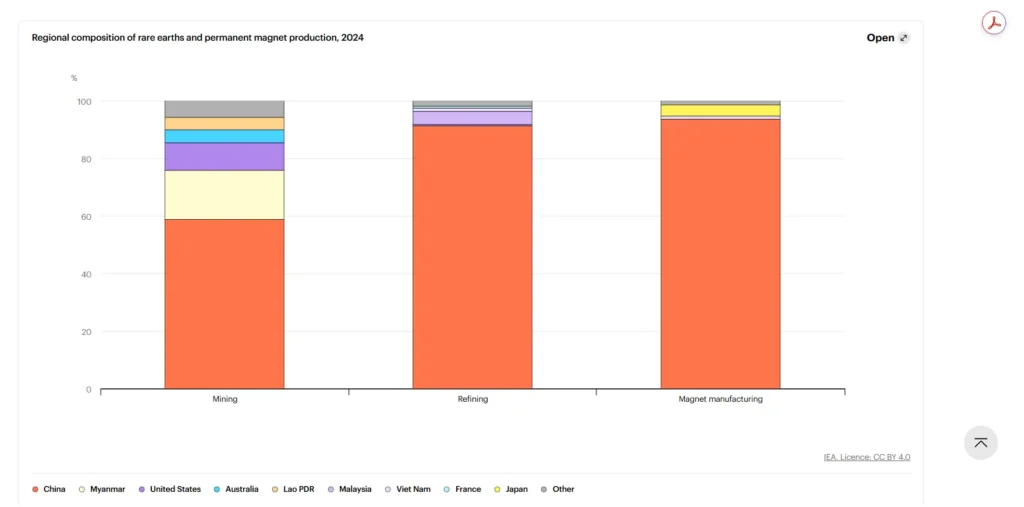
Similarly, China accounts for 70% of the world’s indium, a rare earth extract of zinc mining, that is used to manufacture indium phosphide, a man-made semi-conductor that has become the backbone of modern AI data centers.
The Declaration on AI by Pax Silica signatories explicitly mentions, “We understand the importance of addressing non-market practices that undermine innovation and fair competition. We believe that coordination is essential to protect private investment from the market distortions of overcapacity and unfair dumping practices, and to preserve a level playing field for innovation and growth. We understand the importance of cooperation on the enforcement of our respective policies to protect sensitive technologies and critical infrastructure from undue access, influence, or control. “
It is this hegemony of China on rare earth elements, and semi-conductor technology that the U.S. wants to target via Pax Silica.
Also Read: What is Pax Silica and why it matters to US and India?