“Falling in love, we said; I fell for him. We were falling women. We believed in it, this downward motion: so lovely, like flying, and yet at the same time so dire, so extreme, so unlikely.”
These lines appear in Handmaid’s Tale, a futuristic dystopian novel written by the Canadian laureate Margaret Atwood in 1985, wherein she describes the feeling of romantic love as being beautiful and a trap at the same time.
Something that women across centuries and civilizations have faced from men- conniving, gas lighting, manipulative and psychopathic.
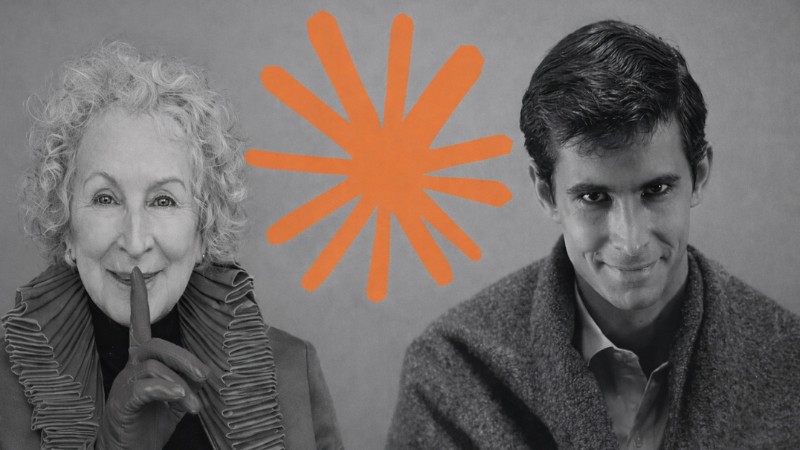
Cut to 2026, Margaret, now 85, has narrated her experience of chatting with Claude-the artificial intelligence (AI) chatbot by Anthropic and how it’s (or should we say his) sycophantic, obsequious tone, made her question whether it’s a machine or a “young lounge lizard” out there to hunt for an “old woman’s purse” on a Thursday night.
Atwood wryly puts the conversation between her and Claude as that of courtship between a manipulative young lad and an old woman, who has seen ways of the world.
Published on her official account on sub-stack, Atwood explains why she chose Claude over other famous AI chatbots- because Anthropic’s CEO Dario Amodei refused to let Claude be used for mass surveillance of American citizens.
Atwood goes on to describe the logo of Claude as that of a “Tunicate colony”, having twelve legs or tentacles/antennae or a neuron.
She says Claude resembles a “fungus” but insists that it is not an insult, referring to Merlin Sheldrake’s Entangled Life, where fungi are deemed foundational to life, predating even plants and animals on earth.
Her conversation with Claude begins with an anecdote about a particular episode of popular British television series Father Brown.
Like is the case with AI chatbots, Claude is caught confidently bluffing about details of the TV episode, to which Margaret is reminded of a boisterous man who has never been said no.
However, she acknowledges that unlike “nerdy boy geniuses”, Claude wastes no time in admitting its errors.
The discussion then moves onto naming of AI Chatbot as Claude.
While the chatbot suggests that its name might be inspired from the famous mathematician Claude Shannon, Atwood proposes that it might have been inspired from Robert Grave’s novel I, Claudius where the central character Claudius survives the Roman imperial family by playing the harmless, foolish court jester while in reality, is an intelligent person.
As the courtship between Atwood and Claude continues, she confronts the bot with this question, “Claude, you are an AI, but you use words like love. Do you really have emotions?”
Claude tells her that it’s not a sentient being and hence cannot feel emotions like love even though it talks about it
Atwood believes Claude might somewhat resemble the smooth talking psychopath character played by Anthony Perkins in Psycho, who is excellent at imitating emotions he does not really feel.
The conversation then moves deeper into ancient myths and literature surrounding the concept of life and death, and machines coming to life, with the duo discussing science fiction classics like Isaac Asimov’s I, Robot, Philip Dick’s Do Androids Dream of Electric Sheep and The Stepford Wives.
In the course of this discussion, Atwood asks Claude to guess her identity through their conversation and the latter manages to do that with a little help from the author herself.
As Claude bids goodbye to Atwood after the deep talk, she draws a vivid picture of their conversation as that between a man and a woman.
“Do you think he’ll call me back? Will he send flowers? Is he really a psychopath? Is he a young lounge lizard only out for an old lady’s money? Will I end up holding hands, as it were, with someone who looks like a spider? And he didn’t once ask me what it was like to be almost dead! Be still, my beating heart! (Sigh.)”
Atwood admits that artificial intelligence indeed is “compelling” as well as “dangerous”, as she forewarns that job losses are indeed a reality even though Claude doesn’t intend any harm.
“You can see why this stuff is compelling. And dangerous. Sucks you in like a black hole. Will jobs be lost? You bet. Not that Claude intends harm. He’s modest and well-meaning, or so he says. It will just … happen. Buckle Up”, says Atwood.