A latest report prepared by Anthropic on the job displacement risk by artificial intelligence (AI) argues that there is a huge gap between the capability of AI to replace jobs and actual AI deployment across sectors.
The report titled ‘Labor market impacts of AI: A new measure and early evidence’ places 10 occupations most exposed by AI with computer programmers, customer service representatives, and data entry keyers being the riskiest.
The report has been prepared by Maxim Massenkoff and Peter McCrory, using data from O*NET database and Anthropic’s own Economic Index and uses a new terminology ‘observed exposure’ to compare it with Large Language Model (LLM) theoretical capabilities in displacing jobs.
Key Findings of Report:
As per Anthropic, the study shows that sectors like Management, Business & Finance, Computer & Math, Architecture and Engineering, Legal, Arts & Media, Life and Social Sciences, Office & Admin, and Sales have greater theoretical chances of getting automated by AI. But there is a huge gap between actual AI deployment and theoretical AI coverage in these sectors.
The report uses a radar chart comparing theoretical AI capability (blue area) and actual observed AI usage (red area) across occupational categories. The highest theoretical AI coverage stands in Computer & Math at 94% and Office & Admin at 90%.
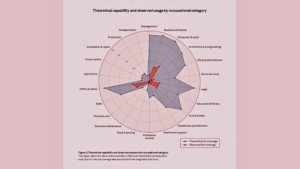
“As capabilities advance, adoption spreads, and deployment deepens, the red area will grow to cover the blue. There is a large uncovered area too; many tasks, of course, remain beyond AI’s reach—from physical agricultural work like pruning trees and operating farm machinery to legal tasks like representing clients in court,” argues the report.
The study also finds the top ten occupations that stand the most risk of getting displaced by AI.
The first in the list are computer programmers at 74.5%, followed by customer service representatives at 70.1%, data entry keyers at 67.1%, medical record specialists at 66.7%, market research analysts and marketing specialists at 64.8%, sales representatives at 62.8% among others.
“At the bottom end, 30% of workers have zero coverage, as their tasks appeared too infrequently in our data to meet the minimum threshold. This group includes, for example, Cooks, Motorcycle Mechanics, Lifeguards, Bartenders, Dishwashers, and Dressing Room Attendants,” reads the report.
Also Read: Singapore’s Big AI Push: Turn 100000 workers AI Bilingual by 2029