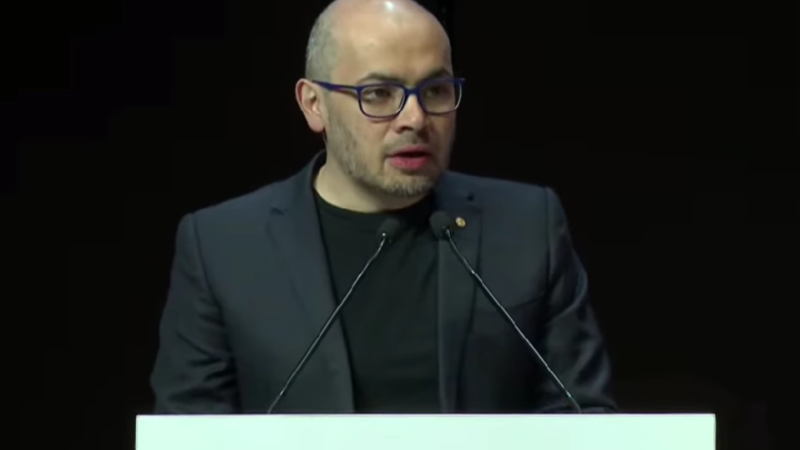
Speaking at AI Impact Summit 2026, Demis Hassabis, CEO of Google Deepmind said that the world may be just “five to eight years” away from artificial general intelligence (AGI), terming the present as a “critical moment” in AI history as humans have already started to see early versions of autonomous, agentic AI systems.
“We are witnessing a critical moment where we can see AGI on the horizon, maybe in the next 5-8 years. AI is indeed going to be one of the most, if not the most, transformative technology in the entire human history. Personally, I am most excited about using AI to improve drug discovery, human health, material science and climate research,” said Hassabis.
Hassabis is one of the top speakers at the five day AI Impact Summit 2026 in New Delhi, India, where over 500 top AI leaders, government heads, policy experts and academicians from over 100 countries are attending.
Also Read: AI Impact Summit 2026: Red Carpet Rolled, Lights Up — Global Titans Turn to India
Hassabis claimed that AI could bring a “golden era” of scientific discovery, where breakthroughs would happen faster and across many different fields.
At the same time, he made it clear that we have not yet reached true AGI. Today’s AI systems still have important weaknesses. “One of the biggest issues is what I would call consistency,” he said. He explained that current systems are like “jagged intelligences.” For example, they can solve very difficult maths problems at the level of the International Maths Olympiad, but sometimes they make mistakes in simple arithmetic if the question is asked in a different way. They also struggle with long-term planning and continuous learning.
Looking back, Hassabis said it has been “amazing to see the progress in just over a decade” since DeepMind was founded in 2010. Early AI research was inspired by how the human brain works. He said reinforcement learning became successful because “learning is key, not being programmed.” Modern AI systems learn from data, and this shows how efficient the human brain really is.
Hassabis said India is positive about AI, become proficient with AI tools as it will help in business science, solving incredible things and many more.
However, Hassabis also warned about risks. He spoke about possible misuse by bad actors, geopolitical tensions, and bio and cyber threats. Since AI is already strong in cyber capabilities, he said we must build better AI-based cyber defenses. International cooperation, he stressed, is essential to make sure AI benefits the whole world.