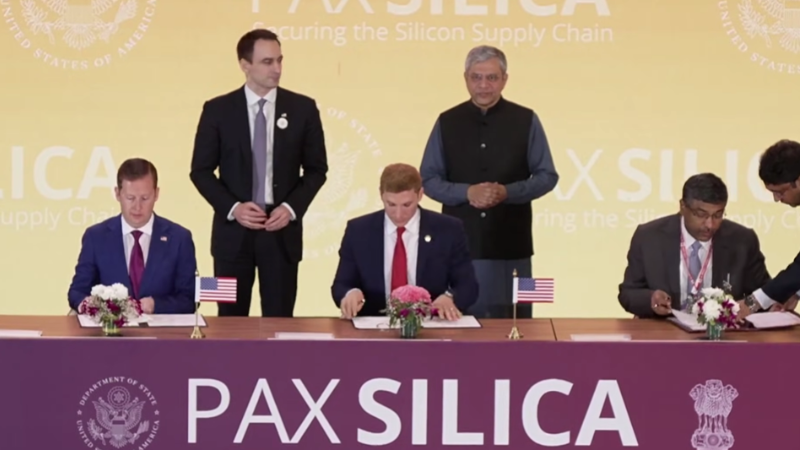
India and the United States have taken a major step towards greater technology cooperation with the signing of the Pax Silica Declaration at the India AI Impact Summit 2026 in New Delhi.
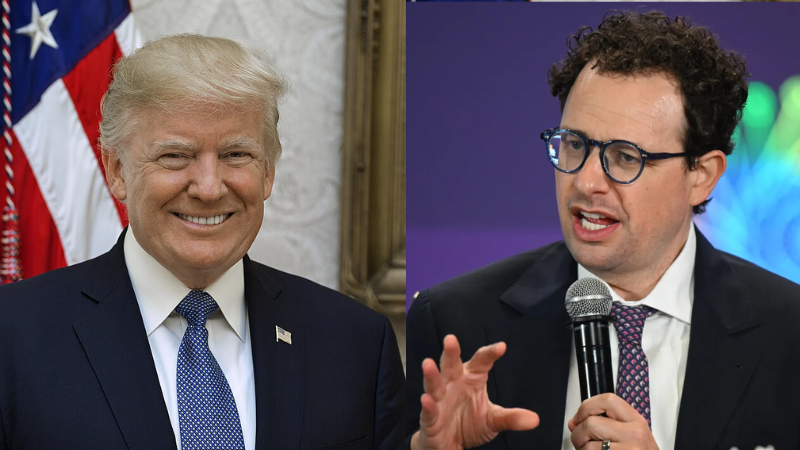
The agreement was signed by India’s IT and Electronics Minister Ashwini Vaishnaw and US Under Secretary of State Jacob Helberg, in the presence of US ambassador to India Sergio Gor.
This declaration reflects a shared concern: the global digital economy is becoming increasingly vulnerable to geopolitical tensions, supply chain shocks and concentration of critical technologies. Both countries will work together to secure access to AI chips, semiconductors and infrastructure that is required for advanced computing.
What is Pax Silica Agreement between US and India?
Pax Silica is a US-led initiative with an aim to build stable and trusted supply chains for the technologies including artificial intelligence and next-generation computing. Pax Silica focuses on advanced hardware components, semiconductor chips, silicon and rare minerals.
The name itself is symbolic:
1. Pax for stability and cooperation
2. Silica for silicon, the backbone of modern electronics.
Pax Silica is a techno-economic framework. It’s meant to align policies, investments, industrial capacity, and standards so countries aren’t overly dependent on any single supplier or region.
Why Pax Silica Matters to India?
For India, joining Pax Silica carries real strategic weight.
It helps in improving access to vital technologies. India still depends heavily on imports for advanced chips and key raw materials. It helps India to move up the technology value chain. While India is strong in software and IT services, its footprint in chip manufacturing and advanced hardware is still developing. With Pax Silica India will not be treated just as a buyer, but as a partner in production, research, and standard-setting. It strengthens India’s appeal in front of global investors. With this partnership, semiconductors and AI deal become easy. It boosts India’s strategic positioning in the world. As whole world become witness how trade wars, and crises can disrupt supply chains overnight in last few years.
According to Mohammad Khalid, Retd. Professor of Panjab University in Chandigarh “as the demand for rare earth metals has grown fast it has become incumbent to secure its supply chains so that any country or region does not throttle the supplies adversely impacting the industry related to advanced technologies such as semiconductors, artificial intelligence (AI) infrastructure, critical minerals. In December 2025 United States took an international initiative called PAX Silica focusing on strengthening and coordinating uninterrupted supply chains of rare earth metals. China is said to hold about 70 percent market share in refining some strategic critical minerals. Many countries joined this initiative initially in December 2025 and some joined it later. India too, being dependent on the critical minerals for its growing AI projects, has joined Pax Silica on February 20, 2026.”
Pax Silica’s Impact on AI and Semiconductors
For training large models of AI, there is need of high-performance chips. India-US partnership through Pax Silica could make easy for India to implement AI in healthcare, government, agriculture and in many more sectors.
In case of Semiconductor, Pax Silica initiative can help collaboration with global players in manufacturing, supplying sources as well as research and development. This leads to generation of high-skill jobs in AI engineering, testing and chip designing.
The relationship between AI and semiconductors has become a high-stakes “virtuous cycle.” While generative AI demands massive computational power, it is simultaneously providing the tools to build its own engines faster than ever before.
The Design Revolution
Traditionally, designing a microchip was an exhausting, multi-month process of trial and then error. Today, AI-driven platforms are compressing that timeline from months into hours, for example, Alpha Chip. AI optimizes Power, Performance, and Area (PPA) with a precision humans can’t match. It can even predict nanometer-scale thermal issues before a single wafer is produced, significantly boosting manufacturing yields.
The “Silicon Squeeze”
Despite these efficiencies, the industry faces a growing divide. Demand is so concentrated on high-end GPUs and NPUs that a “silicon squeeze” is taking hold. While tech giants capture record value, smaller players struggle to secure the specialized hardware needed for edge computing and healthcare applications.
Criticism
We are witnessing a fundamental rewrite of the semiconductor playbook. The challenge is no longer just about making chips smaller; it’s about navigating supply chain fragility and the immense energy costs of production. AI is the architect of the future, but our infrastructure must now race to keep up.
Some policy makers called Pax Silica as forward looking framework while some analyst worry about India’s strategic autonomy. Geopolitically, experts are concern about joining a tech coalition as it could complicate relations with countries that see such frameworks as exclusionary. Critics take Pax Silica as not a binding treaty, they are pointing on dispute resolution and guarantees.
The Road Ahead for Pax Silica: Walking the Tightrope
Overall, according to experts, Pax Silica is seen as a timely response to real time vulnerabilities in AI and semiconductor supply chains. If we particularly talk about India, this deal offers access, investment, and influence—but only if handled with care.
The real test won’t be the signing ceremony and claim to become superpower with AI or dealing about anything. It will be whether India can use this partnership to strengthen its own capabilities, protect its strategic independence, and deliver tangible benefits to industry and workers.
For India, this initiative offers many opportunities in technology access, industrial growth, and strategic partnerships.
“Having a substantial share in global cutting-edge technologies, India too wants to join this international effort to ensure the supply chains of critical minerals. But the moot question is weather India or other countries have of PAX Silica have strength to make China bend to share its resources without putting some strings. China is no Iraq or other weak oil rich country who can be forced or coerced to strike a deal with the needy countries. China being a powerful economy and a notable military strength will bargain for these minerals on its own terms. India too can approach China bilaterally as it is China’s largest trading partner in South Asia and holds certain bargaining chips to convince China share its critical resources. This can be ensured diplomatically rather than through force or coercion,” added Professor Khalid.
In the years ahead, Pax Silica could become a cornerstone of the global AI and chip ecosystem. If not, it risks becoming another ambitious framework with limited on-ground impact. But its ultimate impact on India will unfold not just through agreements signed at summits, but through years of policy execution, innovation, and careful balancing of national interests. It will be interesting to see India’s next step in this direction as the outcome will depend on what India does next—not just what it signed.
Neelam Sharma is a passionate storyteller, and journalist with over a decade of experience across leading Indian media houses.
Known for her calm presence on screen and powerful storytelling off it, Neelam brings a rare blend of credibility, creativity, and empathy to journalism. Her strength lies in ground reporting and research-driven narratives that connect with the heart of the audience. Whether covering social issues, human-interest features, or breaking news, she combines factual depth with a human touch—making every story not just informative.
Vaibhav Jha is an Editor and Co-founder of AI FrontPage. In his decade long career in journalism, Vaibhav has reported for publications including The Indian Express, Hindustan Times, and The New York Times, covering the intersection of technology, policy, and society. Outside work, he’s usually trying to persuade people to watch Anurag Kashyap films.