Merely two days into the India AI Impact Summit 2026- a certain private university from Delhi has hogged the spotlight at the world’s largest artificial intelligence (AI) summit for rather embarrassing reasons.
Controversy erupted at AI Impact Summit when a team from Galgotias University displayed a robotic dog named “Orion” at their exhibition, reportedly claiming to have developed it under the university’s Centre of Excellence AI project.
Social media users were quick to identify the robo-dog as the publicly available Unitree Go2 — a quadruped robot made by Chinese firm Unitree Robotics — that the university allegedly purchased and passed off as their own innovation.
The issue soon snowballed into a major faux pas moment for the Indian government and the university was asked to vacate the exhibition stall.
As is the case with every outrage cycle that begins on social media, the issue was picked up by national and international press as well as the Indian opposition leaders who termed the summit as “disorganized PR spectacle”.
All of a sudden, AI Impact Summit 2026-that is hosting over 20 Heads of State, 60 Ministers, and 500 global AI leaders- and is billed as the first AI meet in the Global South, has been reduced to a gimmicky product by a private university.
The AI Impact Summit is a mammoth scale umbrella event that is hosting an intersection of complex policy discussions, technological showcases, investors’ marketplace and geopolitical liasoning, all under one roof, in New Delhi.
The summit occurs at a time when the U.S. President Donald Trump has arm-twisted nations with tariffs to assert American dominance while China has been relentlessly building AI infrastructure. In more ways than one, the AI Impact Summit 2026 intends to act as a Global South anchor where countries including India seek ways to achieve “sovereign AI”.
According to the Indian government, the summit is anchored in three foundational pillars (Sutras in Sanskrit)- People, Planet and Progress- defining how AI should serve humanity, safeguard the environment and drive inclusive economic and social growth.
Also Read: AI Impact Summit 2026: Red Carpet Rolled, Lights Up — Global Titans Turn to India
Experts predict that in the next 10 years, the AI industry will push the global GDP by $7 Trillion, and those are by modest standards. The ongoing AI Impact Summit 2026 is also going to be beneficial for India as the union IT minister Ashwini Vaishnaw claiming an investment of over $200 Billion in the next two years.
As artificial intelligence makes its lightning advance, embedding into our daily lives and impacting our livelihood, it becomes imperative for stakeholders (read People) to seek accountability from AI industry leaders, policy experts and decision makers through this summit.
While the core theme of the summit remains democratization of AI resources, safe and trusted AI and inclusion for social empowerment among others, there are a lot of questions that demand urgent attention from stakeholders.
This year’s AI Summit like its predecessors in France, South Korea and U.K. is expected to not end with any politically binding agreements between nations and rather slide towards non-binding declarations or goals related to AI. This begets a question as to when we can actually see commitments beyond mere lip service.
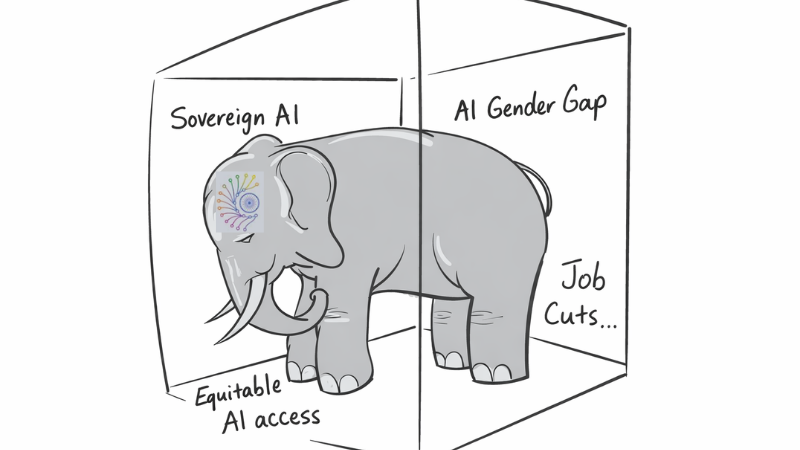
Moreover, the summit explicitly talks about democratizing AI and ensuring that its access reaches to the last person in a democracy yet the biggest deals announced have involved Google, OpenAI, NVIDIA, Adani and Reliance. How are our lawmakers going to ensure that India doesn’t continue being the “use-case” capital of the AI world, where the laborious task of training AI models is outsourced by the west.
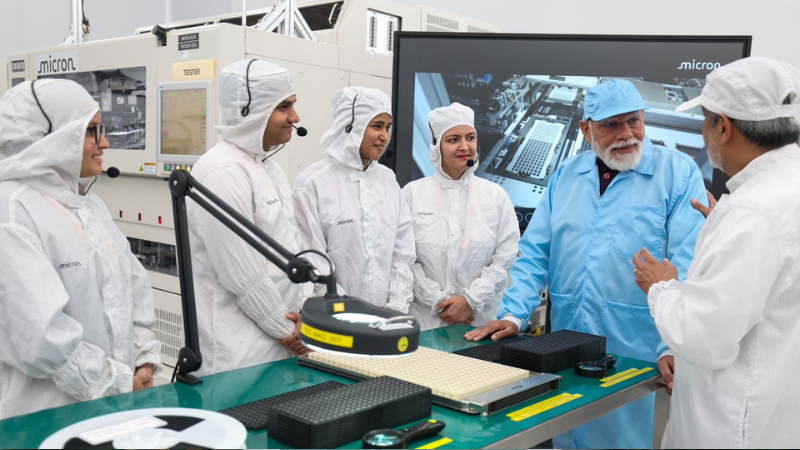
India wants to frame herself as the Global South AI leader, yet its AI sovereignty dreams run up against hardware dependencies (compute infrastructure) controlled tightly by the U.S. and China. Numbers tell the story-India has just one under-construction mega-fabrication facility in Gujarat, compared to 44 in China and 15 in the U.S.A. India accounts for mere 3% of the global semiconductor market.
The summit can also serve as an opportunity to talk about how crucial is equitable distribution of AI resources so that its benefits are not limited to the elite few while the ordinary many get to live with its consequences.
The AI industry is predicted to displace more than 300 million jobs globally in the coming few years. With India’s unemployment rate rising to 5% in January 2026 from 4.8% in December 2025, and 66% of country’s unemployed being graduates and postgraduates, the summit calls for urgent action pointers to deal with the impending job cuts. Moreover, the urban female unemployment sits at 9.8% and the gender gap is likely to continue in AI sector if urgent steps are not taken.
Also Read: Women in AI: Closing the Gap from Global South Up
Democratizing AI education access is another necessary factor that we must take account of. AI curriculum is the hottest trend in universities worldwide and students in India would also want to seek their dream careers in AI. According to the Academic Ranking of World Universities (ARWU) 2025 — otherwise known as the reputed Shanghai Ranking- not a single Indian university has made it to the Top 500.
With such an alarming state of our higher education, it should be our priority to funnel more resources into indigenous AI research and encourage innovation.
The AI Impact Summit 2026 is supposed to be the first anchor event in Global South before the world fully adopts the technology. One private university’s embarrassing stunt should get its 15 minutes of attention and rightly deserved criticism. But it should not deter the media, opposition and civil society in general from asking the right questions to the stakeholders, admit our institutional weaknesses and work towards a just, sustainable and equitable AI embedded future.