Renowned AI scholar Kate Crawford in her book Atlas of AI, argues, “AI is neither artificial nor intelligent. It is made from natural resources and it is people doing the work.”
Crawford’s comments succinctly highlight the great divide between the global north and the global south, where the brunt of data training, annotation and moderation is outsourced to developing nations while few corporations in the advanced nations reap its benefits.
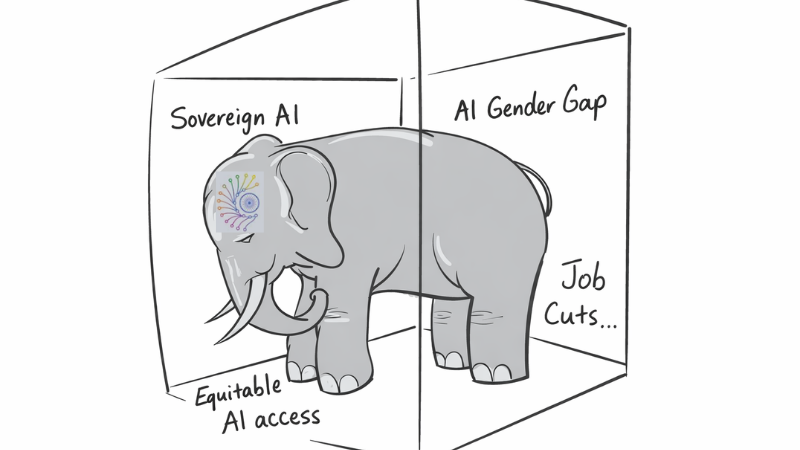
This year’s AI Summit is being held in New Delhi as India positions itself as the Global South’s anchor in the race for what is increasingly being called ‘Sovereign AI’.
It aims to build on the momentum generated by leading international forums such as the UK AI Safety Summit, the AI Seoul Summit and the France AI Action Summit.
AI has proliferated across industries and disrupted conventional patterns and established processes in society. Recognizing the need to move beyond frameworks and high‑level political statements, the summit seeks to chart a path toward a future in which AI facilitates growth, social development, and innovation.
At the same time, it aspires to ensure that these opportunities do not remain concentrated in narrow pockets but are shared broadly, enabling many nations to prosper. Taking place only a few weeks after the World Economic Forum convention at Davos, in which the idea of sovereign AI drew great attention and led to considerable dialogue, the summit could prove to be the platform that advances this priority.
What is Sovereign AI?
Sovereign AI refers to the ability of a nation to develop and operate its own AI infrastructure and systems. The emphasis here is on strategic autonomy. Sovereign AI is increasingly seen as a necessary prerequisite for digital autonomy and sovereignty in the modern age. It is crucial for all nations as it underpins the key areas of national security and data privacy.
Race for AI Dominance between US and China
The AI space today is dominated by American and Chinese technology companies. American firms are at the forefront when it comes to foundational model development and are home to leading research institutions. They have also taken massive strides in semiconductor innovation, and the venture capital ecosystem there facilitates entrepreneurship and risk‑taking on a scale that is difficult to match.
China, on the other hand, has an AI strategy backed by the state itself. Its AI policy has been integrated into national industrial policy as well.
The result is an asymmetric global AI order in which power is concentrated largely between these two actors.
Consequently, many countries want to prevent situations where they are excessively dependent on either of these two powers and are working towards building independent AI infrastructure and capabilities.
Democratization of AI
The democratization of AI is a central idea shaping India’s technological trajectory. By keeping people at the center of progress and envisioning AI as a tool for large‑scale social impact, India is working to maximize its capabilities through the creation of an integrated AI stack. In a systematic approach, India is addressing each layer, including energy, data centers and network infrastructure, compute, AI models, and applications, in order to expand capacities across the ecosystem.
Also Read: Women in AI: Closing the Gap from Global South Up
Would India Gain from AI Impact Summit 2026?
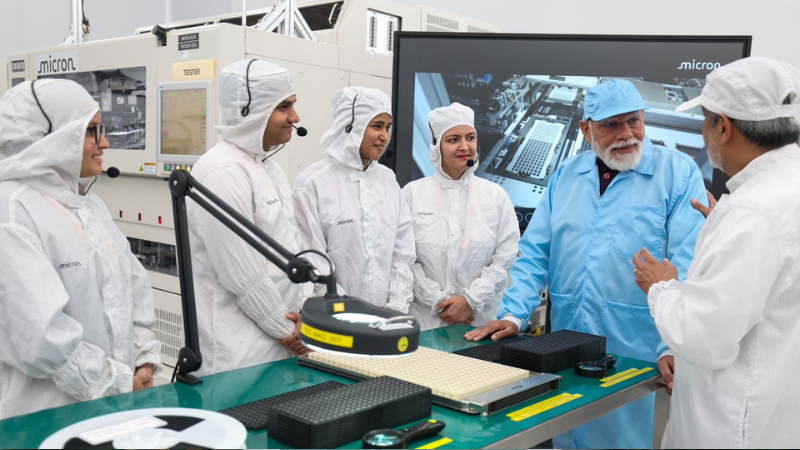
Under the IndiaAI Mission, indigenous AI models are being developed to address India‑specific use cases within the model layer of the stack, with the stated aim of creating a sovereign, inclusive and application‑oriented AI model ecosystem. The computer layer is being strengthened through initiatives such as the India Semiconductor Mission, which has approved multiple semiconductor projects, including chip fabrication and packaging facilities, alongside efforts to expand access to affordable computers through government‑supported cloud infrastructure and the IndiaAI Compute Portal. In the network‑infrastructure layer, India has secured major commitments from global tech giants such as Microsoft, Google and Amazon, which are set to make significant investments in new data‑centre and connectivity infrastructure hosted within the country.
All this rests on top of the energy layer, which powers everything. To meet the increase in energy demand, the government is preparing for a historic transformation in the power sector. India’s total installed electricity capacity has already surpassed 500 GW, with non‑fossil sources accounting for over half of that capacity, and the country plans to achieve 57 GW of pumped‑storage projects and 43,220 MWh of battery‑energy‑storage systems by 2031–32, according to a recent official press release on the India AI stack and energy transition.
Conclusion: India’s Moment or India’s Mirage?
India is building a sovereign, inclusive and application‑oriented AI model ecosystem. Similarly, countries are now actively planning and collaborating with each other to ensure they have robust and independent AI ecosystems and are less dependent on the leading players in this space, the US and China. The recently announced joint India-EU Strategic Agenda, which makes provisions for knowledge exchange, collaborations, reciprocal talent exchange and the promotion of research cooperation in emerging technologies, strongly suggests that coordination and cooperation may be key to achieving mutually shared objectives and goals.
The India AI Impact Summit represents a tangible step towards the realization of these goals, as policymakers, researchers and industry leaders from across regions convene to determine the trajectory of AI in the future. India can potentially act as a bridge between the advanced players in this field and the emerging players of the Global South. If India successfully aligns the interests of sovereign capacity and inclusive growth, it could play a key role in shaping a more equitable global AI order.