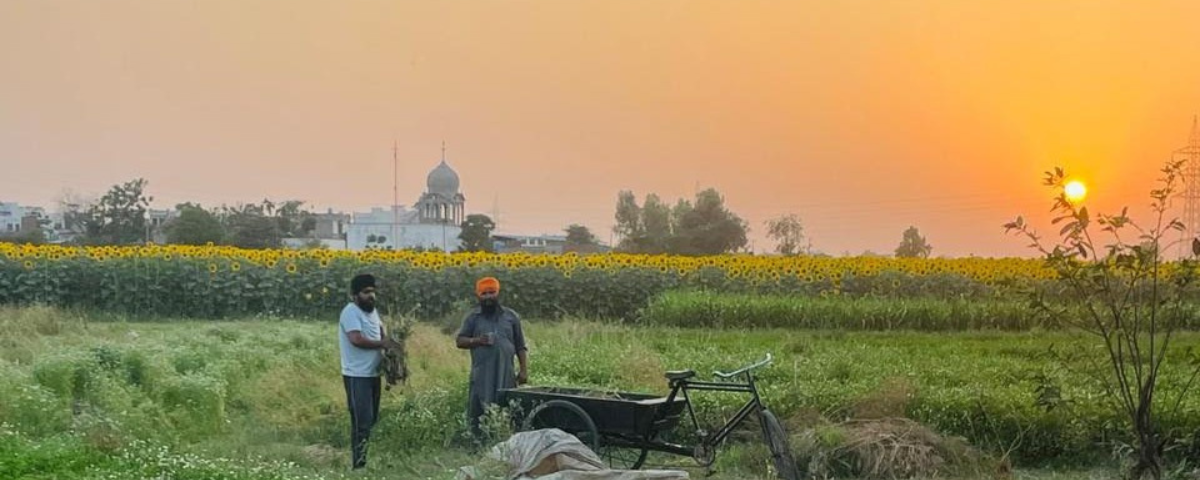
In a small village ‘Bhedwal’ in Punjab state of India, farmer Gurinder Singh Bhangu begins his day before sunrise, even as the tranquil chants of ‘Gurubani’ (sacred hymns of Sikh gurus) wafted from the nearby Gurudwara (temple).
March is a high-pressure transition month for farmers in Punjab, the northern state of India known as the ‘food bowl’, as they manage the final stages of Rabi (winter) crop while preparing for Zaid (summer sowing).
For generations, farmers like Bhangu have followed a simplistic pattern of observation and experience for their livelihood- check the sky for signs of rain, look carefully at crops to spot pest damage, and decide how much water or fertilizer the field might need.
Today, however, a new kind of adviser is slowly entering Indian farms — artificial intelligence (AI).
With AI, farmers can get early warning signs to detect crop stress or pest outbreaks before they become visible to the human eye. Weather data can help predict rainfall patterns and guide farmers on when to sow their crops. AI tools can also suggest the right quantity of fertiliser and irrigation required, helping farmers reduce costs while improving yields.
AI systems can analyze large volumes of data collected from satellites, weather stations, soil health records, crop histories, and even smartphone images of plants. Once processed through machine-learning systems, this data can generate recommendations for farmers.
Voice-based AI platforms are also being developed to provide farming advice through mobile phones in regional languages. Farmers can ask questions about pest control or irrigation and receive guidance instantly.
It sounds lucrative on paper, no doubt about it, but implementation of this advanced technology is an all-together different game. For farmers like Bhangu, their contact with AI is more or less limited to watching Gen AI slop videos on Instagram and YouTube.
Bhangu emphasizes that farmers already have deep knowledge about their crops and seeds.
“Farmers understand their own seeds very well. Nothing significant has been done to increase farmers’ income. If agricultural policies remain weak, technology alone will not change anything. If things are implemented practically, only then will farmers see results,” he says.
The Promise of AI in Farming
Bhangu’s skepticism is not unique to Punjab. Across India, governments are betting heavily on AI to modernize agriculture — none more ambitiously than Maharashtra, which has unveiled a five-year Maha Agri-AI Policy 2025–2029, targeting the very problems farmers like him describe.
The policy aims to use artificial intelligence and digital technologies to support farmers. The goal is to combine data, technology, and local knowledge to make farming more productive.
To promote innovation in this area, the Maharashtra government has invited startups, universities, NGOs, and researchers to develop AI-based agricultural solutions. The scheme includes two categories. Early-stage ideas can receive funding of up to ₹40 lakh to develop prototypes, while more advanced technologies can receive up to ₹2 crore for field trials and pilot projects on farms.
Despite these initiatives, many farmers say that technology cannot replace basic agricultural support systems.
“Practical Work Matters More Than Technology”
Farmer Gurinder Singh Bhangu also stresses the importance of Minimum Support Price (MSP). “If farmers receive MSP for their crops, it will provide financial stability. Without fair prices, new technology will not solve farmers’ problems.”
He also highlights a major challenge in rural areas: the digital gap.
“Many farmers do not have smartphones, technological knowledge, or experience with digital tools. Without proper understanding, such technologies could lead to more losses rather than benefits,” he warns.
Lack of Awareness Among Farmers
Another farmer, Jangvir Singh Chauhan, says the biggest challenge is awareness. “Farmers simply do not have enough information about these programmes,” he explains. According to him, many farmers are still unaware of how digital agriculture initiatives work. “There is a lack of awareness. Often men attend meetings along with women, but many farmers still do not clearly understand these schemes.”
Chauhan also believes that economic issues must be addressed before introducing advanced technology. “If farmers receive MSP for crops like wheat and rice, their situation will improve immediately,” he says.
He also points out that farmer suicides remain a serious concern in several parts of India. “If farmer suicides are happening even when governments claim strong support for agriculture, it means there are serious shortcomings in the system.”
Chauhan further raises concerns about duplicate seeds, which can destroy crops and cause significant financial losses for farmers. “Before talking about AI, the government must ensure that farmers are protected from fake seeds and poor-quality inputs,” he adds.
Infrastructure Remains a Major Concern
Farmer Guramneet Singh is even more skeptical about AI in agriculture. He believes the conversation around artificial intelligence often ignores the lack of basic infrastructure in rural areas.
“AI is being promoted as a big solution, but farmers want to know what they will actually gain from it,” he says.
According to Guramneet Singh, many villages still struggle with unreliable internet connectivity.
“In many remote areas there is no proper cellular network. Even in Punjab there are places where the internet does not work properly. Without proper infrastructure, such technologies cannot succeed.”
He also questions whether AI can solve the real problems faced by farmers. “Can AI stop duplicate seeds? Can it ensure MSP? Can it solve pesticide problems or remove weeds from fields?” he asks.
Guramneet Singh also highlights the impact of natural disasters.
“In states like Maharashtra, farmers sometimes face floods and droughts in the same year. Crops are destroyed, but compensation often comes late.”
He argues that even basic digital systems are not always reliable.
“Sometimes bank servers do not work, electricity supply is unstable, and networks fail. If the basic systems are not functioning properly, how will advanced digital solutions work?” Summing up his view, Guramneet Singh says technology should not be exaggerated. “AI may explain how to make a roti, but it cannot actually cook it.”
Women Farmers and the Digital Divide
The Maharashtra AI policy also highlights the important role of women in agriculture. Women make up nearly 43 per cent of India’s agricultural labor force and contribute significantly to crop production, livestock care, and rural household economies. However, their contributions often remain unrecognized.
Women own only about 13–14 per cent of operational landholdings in India, and their access to institutional credit is limited. They are also less likely to own smart phones or use mobile internet compared to men. Studies suggest women are 15–20 per cent less likely to own smart phones, creating a digital divide that could prevent them from benefiting from AI-based tools.
Experts believe that AI policies must address this gap. As Soumya Swaminathan, chairperson of the MS Swaminathan Research Foundation, has noted, in her article for The Indian Express, published on March 11 this year.
“If AI strategies integrate gender-smart design, correct data asymmetries, and close digital access gaps, the technology can accelerate not just productivity but equity. Another challenge is the type of agricultural data used to train AI systems. Much of the available data focuses on crops such as wheat and rice, which are major commercial crops. However, women are often more involved in sectors such as millets, pulses, horticulture, backyard poultry, and small livestock farming. Because these activities are less documented in digital datasets,” opined Swaminathan in her article.
Technology as Support, Not Replacement
Supporters of AI emphasize that the technology is not meant to replace farmers’ knowledge or experience. Instead, it can serve as a support system — providing early warnings, analyzing complex data quickly, and offering timely advice.
Even a 5–10 per cent improvement in productivity could significantly improve rural incomes if implemented effectively.
However, farmers say the success of AI in agriculture will depend on solving basic issues first. These include reliable internet connectivity in villages, digital literacy among farmers, fair crop prices through MSP, protection from fake seeds and pesticides, and stronger agricultural policies.
If these challenges are addressed, AI could become a useful tool in modern farming.
But until then, many farmers believe that technology alone cannot transform agriculture without addressing the realities on the ground.