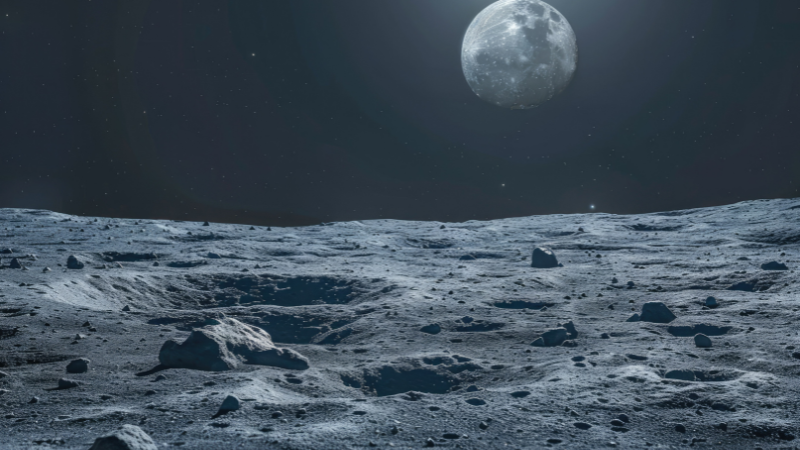
What happened when scientists in China let an artificial intelligence (AI) model study a 1.9-kilogram (4 lbs) rock and soil sample collected from the unexplored side of the moon- the South Pole-Aitken Basic impact crater.
The deep analysis by AI led scientists to create the first high-precision global map of the moon’s far-side chemical composition offering new insights into one of lunar science’s long-standing mysteries- the chemical structure of the half of the Moon that permanently faces away from Earth.
The research was led by the Shanghai Institute of Technical Physics along with scientists from Tongji University and other Chinese institutes. Their findings were published in the peer-reviewed journal Nature Sensors.
For decades, scientists had detailed chemical data only from the Moon’s near side because missions such as Apollo program, Luna program, and Chang’e‑5 collected samples there. The far side’s rugged terrain and unusual minerals made it difficult for orbiting instruments to accurately determine its chemical makeup.
It was finally in 2024 that the Chinese expedition ‘Chang-6’ returned with 1.9 kilograms of soil and rock samples from the massive South Pole–Aitken Basin, the Moon’s largest and oldest known impact crater, that faces away from the earth.
Scientists used these “ground-truth” samples to train an AI model, combining them with existing lunar data and high-resolution images from Japan’s Kaguya mission.
Using this AI-assisted approach, researchers mapped the distribution of six key oxides on the Moon — iron, titanium, aluminum, magnesium, calcium and silicon. The map also clearly identifies chemical patterns across the Moon’s major regions, including the dark basaltic “maria,” the bright ancient highlands, and the South Pole–Aitken basin.
The results support theories about the Moon’s early lunar magma ocean, a global molten layer believed to have cooled unevenly billions of years ago, creating major differences between the near and far sides.
Observers believe the undisclosed mini-rover may explore the far-side terrain after the spacecraft lands, although its exact purpose has not yet been revealed.
Scientists say the new chemical maps could help guide landing site selection for future lunar missions and deepen understanding of the Moon’s geological evolution.