Artificial Intelligence (AI) at work has hit a tipping point. Adoption has surged, but workers, trust, and strategy remain misaligned.
AI is no longer emerging in the workplace; it is already embedded at scale. Yet the narrative around it appears inconsistent.
- One dataset shows half of workers already using AI
- Another shows limited regular usage and rising concern
- A third shows widespread organizational adoption
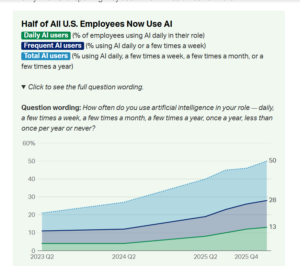
The latest findings from Gallup’s report Rising AI Adoption Spurs Workforce Changes show that AI use in the workplace has reached a new level, with about half of workers now using it. Alongside this, research from Pew Research Center and McKinsey & Company helps explain why adoption, perception, and execution remain out of sync.
These differences are not contradictions. They reflect how the same shift appears through different lenses.
What workers are doing, what they believe, and what organizations are reporting.
Lens 1: What Workers Are Doing (Gallup)
- About 50% of U.S. workers report using AI
- AI use is associated with higher individual productivity
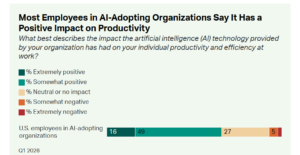
- No widespread transformation of job structures yet
Workers are adopting AI at scale, but the structure of work remains largely unchanged.
Lens 2: What Workers Believe (Pew Research Center)
- 52% of workers are more worried than hopeful about AI’s impact
- Around 20% report regular use of AI at work
- Many workers report limited understanding or relevance of AI tools
Workers are engaging with AI, but confidence in its long-term impact remains limited.
Lens 3: What Organizations Are Reporting (McKinsey)
- Roughly 80–90% of organizations report AI adoption
- Many initiatives remain in pilot or early scaling stages
- Value depends on integration into workflows and business processes
AI is widely reflected in strategy, but not yet consistently embedded in operations.
| Key Differences | ||||||||||||||||||||||||
|
| Key Similarities | ||||||||||||
|
What’s Really Happening Beneath the Numbers?
- A system moving at different speeds
- Workers are using AI
- Workers are unsure about AI
- Organizations are investing in AI
These layers are not yet aligned.
- Adoption has outpaced understanding
AI usage is growing faster than:
- Trust
- Policy
- Organizational clarity
This creates a gap between capability and confidence.
- Transformation is still ahead
- AI is delivering task-level improvements
- Not yet driving end-to-end workflow redesign
Faster work is not the same as transformed work.
Real Story
AI is no longer experimental in the workplace – it’s already part of how work gets done. But it hasn’t fundamentally changed how work is structured. What’s emerging is a clear disconnect.
The workplace is in a misaligned phase where usage, trust, and strategy are evolving at different speeds. People are using AI – often cautiously – while organizations are pushing ahead, still figuring out how to make it truly work at scale. Each is moving at a different pace.
The next phase of AI will be defined less by adoption and more by alignment between behavior, belief, and execution.
Also Read: Growing Up with Generative AI: Pew Study Reveals How Teens are Using It