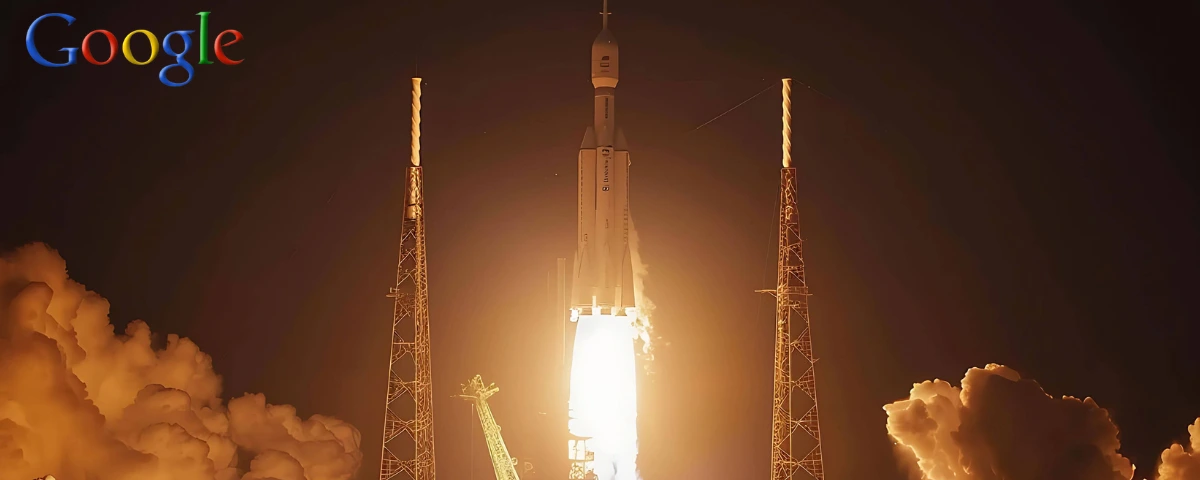
As companies and countries race to expand their AI capabilities, Google is taking the race into space, sending its AI chips into orbit next week under Project Suncatcher.
However, taking AI data-centre infrastructure into space presents major engineering challenges, from launch stress and radiation to extreme temperatures, cooling and satellite-to-satellite connectivity. Google identifies cooling orbital data centres as a key research challenge.
The company will use the mission to test how its Tensor Processing Units (TPUs) perform under the physical and environmental conditions of space. TPUs, or Tensor Processing Units, are specialized AI chips developed by Google for machine-learning workloads.
Google’s prototype satellite will launch aboard SpaceX’s Transporter-18 rideshare mission. The satellite was developed in partnership with Planet. The mission will collect data on how the TPUs handle radiation, thermal extremes and the physical stresses of launch and orbit.
Google CEO Sundar Pichai highlighted the upcoming mission in a post on X, asking whether the company’s TPUs can survive and operate in space. SpaceX founder and CEO Elon Musk also reacted to the post.
— Elon Musk (@elonmusk) September 25, 2026
The first milestone comes next week, when Google plans to put its first TPUs into orbit and collect data on how the chips perform in space. The company’s next test is planned for 2027, when it will put two satellites in orbit to test high-bandwidth laser communication between them.
Google says future satellite designs could eventually carry dozens of TPUs and operate in clusters, pointing toward a longer-term vision of linking multiple satellite constellations to handle larger AI workloads in orbit.
The company says the current mission is an early step in a longer research effort. First announced last year, Project Suncatcher is exploring whether space could eventually support scalable machine-learning infrastructure.