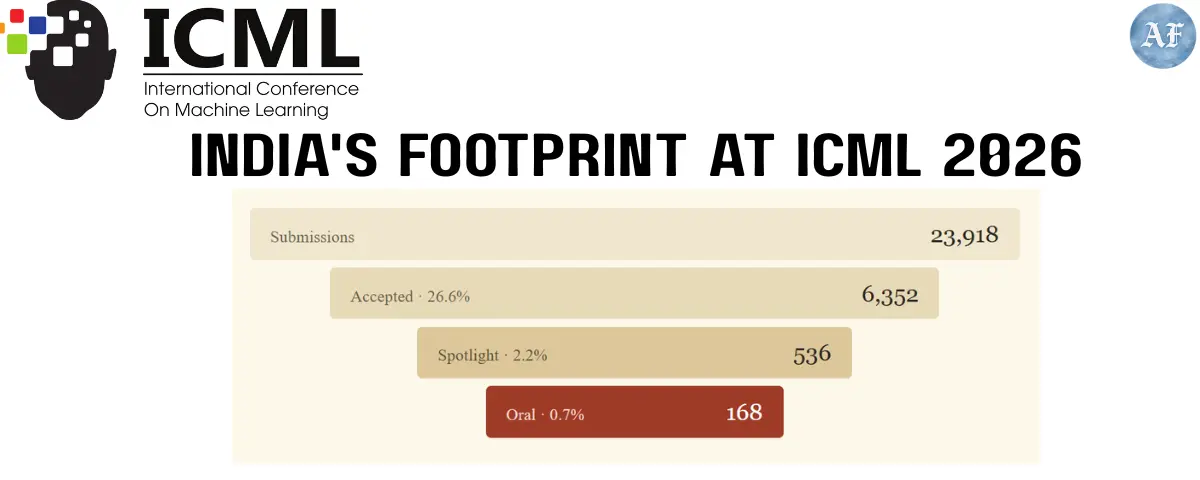
The 43rd International Conference on Machine Learning (ICML) Seoul 2026 will feature fourteen Indian-educated researchers as part of the “orals”- the top-tier 0.7% of all paper submissions at one of the world’s oldest conferences on Machine Learning.
Touted as among the three premier annual ML conferences globally, ICML 2026 kicks off at Seoul, South Korea from July 6-11, with 6,352 accepted papers out of total 23,918 submissions.
Among the 6352 papers, only 168 submissions were selected in the Orals – the highest designation an ICML paper can receive, where the authors are invited to deliver a live talk on-stage during the conference. Similarly, ICML granted 536 paper (including 168 orals) as “spotlight”, marking them exceptional among all submissions.
AI FrontPage examined all 536-spotlight paper submissions, including 168 orals, and found that 14 Indian-educated researchers are part of the Orals while 26 Indian-educated researchers are also part of the spotlight papers, taking the count to 40 for orals and spotlight.
Quick note on research methodology: The names include only those Indian researchers who have pursued at least one higher education degree from an India-based institute.
Orals at ICML 2026: Indian Researchers Share Spotlight
ICML is counted among the world’s three premier ML research venues alongside NeurIPS and ICLR. The six-day conference will be organized at COEX Convention and Exhibition Centre in Seoul and will see some of the finest minds in AI/ML assemble to brainstorm ideas.
Among the orals, 14 Indian educated researchers have been mentioned for their paper submissions.
1. Sagnik Mukherjee
Co-authored Paper: Do We Need Adam? Surprisingly Strong and Sparse Reinforcement Learning with SGD in LLMs
Alma Mater: IIT Kanpur
Current: Graduate Research Assistant, University of Illinois
2. Sunanda Sengupta
Co-authored Paper: Benchmarking at the Edge of Comprehension
Alma Mater: IIT Madras
Current: Principal Research Manager, Microsoft
3. Shreyansh Padarha
Co-authored Paper: Strategic Navigation or Stochastic Search? How Agents and Humans Reason Over Document Collections
Alma Mater: Christ University Pune-Lavasa campus
Current: University of Oxford
4. Vansh Gupta
Co-authored Paper: Position: Anthropomorphic Misalignment Research Needs Stronger Evidence
Alma Mater: IIT Delhi
Current: ML Engineer, Kaiko.AI
5. Daman Arora
Co-authored Paper: Maximum Likelihood Reinforcement Learning
Alma Mater: IIT Delhi
Current: Computer Science and Engineering, Carnegie Mellon University
6. Pradeep Dasigi
Co-authored paper: DR Tulu: Reinforcement Learning with Evolving Rubrics for Deep Research
Alma Mater: VIT Vellore
Current: Allen Institute for Artificial Intelligence
7. Ram Samarth BB
Co-authored paper: FlatLand: Personalized Graph Federated Learning via Tailored Lorentz Space
Alma Mater: Indian Institute of Information Technology Kottayam
Current: Microsoft
8. Raj Ghugare
Co-authored paper: On the role of computation in reinforcement learning
Alma Mater: Visvesvaray National Institute of Technology, Nagpur
Current: Princeton University
9. Soham Ray
co-authored paper: τ²-bench : Evaluating Conversational Agents in a Dual-Control Environment
Alma Mater: Pune Institute of Computer Technology
Current: Researcher at Sierra AI
10. Bhaskar Ray Chaudhury
Co-authored paper: Equilibrium Pricing in Oligopolistic Data Markets
Alma Mater: NIT Tiruchirappalli
Current: Assistant Professor, Industrial and Enterprise Systems Engineering, University of Illinois at Urbana-Champaign
11. Eklavya Sharma
Co-authored paper: Equilibrium Pricing in Oligopolistic Data Markets
Alma Mater: IISc Bengaluru and BITS Pilani
Current: PhD student at Industrial and Enterprise Systems Engineering, University of Illinois at Urbana-Champaign
12. Jugal Garg
Co-authored paper: Equilibrium Pricing in Oligopolistic Data Markets
Alma Mater: IIT Bombay
Current: Associate Professor, Dept. of Industrial and Enterprise Systems Engineering
Affiliate, Dept. of Computer Science, Univ. of Illinois at Urbana-Champaign
13. Rajat Dwarkanath
Co-authored paper: FlashSketch: Sketch-Kernel Co-Design for Fast Sparse Sketching on GPUs
Alma Mater: IIT Madras
Current: Stanford University
14. Lakshya Agarwal
Co-authored paper: Measuring agents in production
Alma Mater: Indraprastha Institute of Information Technology, Delhi
Current: University of California, Berkeley
Indian Institutes in ICML: IIT Bombay, IIIT Indraprastha, IIT Delhi Take Lead
When it comes to spotlight papers in ICML 2026, researchers from three India-based institutes– Indian Institute of Technology (IIT) Bombay, Indian Institute of Information Technology (IIIT) Indraprastha and IIT Kharagpur, have been selected.
A quantitative analysis of Indian-educated authors sharing the spotlight category shows IIT Delhi and IIIT Indraprastha as alma mater of six researchers, IIT Bombay for 9 researchers, IIT Madras for two researchers, Indian Institute of Science (IISc) Bengaluru for 3, 2 each for DA-IICT, IIT Kharagpur, IIT Kanpur, IIT Hyderabad and BITS Pilani.
Co-Authored Paper: HOBIT: Hardness Optimized Batch Sampling for InfoNCE Training
Authors: Himanshu Dutta, Lokesh Nagalapatti, Yashoteja Prabhu
Institute : IIT Bombay
Co-authored Paper: Uncovering the Latent Potential of Deep Intermediate Representations
Authors: Arnesh Batra, Arush Gumber, Aniket Khandelwal, Jashn Khemani, Anubha Gupta
Institute: IIIT Indraprastha
Co-authored Paper: Catch-22: On the Fundamental Tradeoff Between Detectability and Robustness in LLM Watermarking
Authors: Kuheli Pratihar, Debdeep Mukhopadhyay
Institute: IIT Kharagpur
What Indian Researchers Say About ICML 2026?
AI FrontPage reached out to multiple Indian-educated researchers who attended the ICML 2026 in Seoul, South Korea. One among them is Sagnik Mukherjee, who is all set to present his paper during the orals.
When asked about what is that one biggest thing standing between an IIT/NIT student and getting published at ICML, he says, “I think the encouraging thing is that this is already happening — students from IITs, NITs, and other Indian institutions are publishing at top ML venues, including ICML. So the goal is definitely reachable.That said, the biggest gap is probably research exposure, and I don’t think this is specific to IITs or NITs — it is true for almost anyone trying to enter research. Being around the right mentors, learning how to pick important problems, and developing the taste to frame and execute a strong idea makes a huge difference. Compute matters a lot, especially for LLM research, but it is not the whole story.”
Similarly, Soham Ray, Research Engineer at Sierra, who is presenting two papers at ICML, tau 2 (selected for Orals) and tau voice that are agentic benchmarks in the customer service domain, says he is looking forward to share his ideas at the Seoul conference. Ray is an alumnus of Pune Institute of Computer Technology, who then went to Cornell University to pursue Masters.
“I have strived to build projects that contribute to the community and have a sizable impact outside of the paper: the tau framework is open source and actively used and maintained. It has been incredible to see how quickly and widely tau has been adopted across the industry and its not something I had imagined back in my India days,” says Ray.
When asked about what should an India based student with limited compute, focus on if they want to do ICML-level work, Ray says, “You don’t necessarily need compute to do meaningful work. Benchmarking papers are light on compute requirements, and you can be intentional about your token spend by running experiments on cheaper models before scaling up. I have found distilling industry insights into open source research projects to be incredibly effective.”
Of the 40 researchers AI FrontPage identified, only a handful are currently affiliated with institutions in India — the rest publish from universities and labs in the United States and Europe. The pipeline, clearly, works; what India hasn’t yet built is a reason for it to flow back. As ICML’s doors open in Seoul this week, the question isn’t whether Indian classrooms can produce world-class ML researchers — it’s whether Indian institutions can keep them.
Also Read: On a $2,500 grant, a Chandigarh researcher just cracked ICML