Artificial intelligence has quietly become part of the daily routine for America’s teenagers, embedded to the extent that has got parents and teachers concerned, alike. Under Pew Research Center study “How Teens Use and View AI” published on February 24, a survey conducted online among 1,458 U.S. teens ages 13 to 17, finds nearly two-thirds have used AI chatbots- and almost one in three are using them every single day.
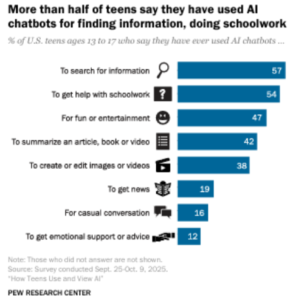
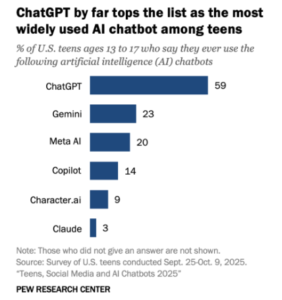
The survey conducted by Pew Research Center between September 25 and October 9, focused on use of Generative AI among students of U.S schools. As per survey results, students were familiar with popular chatbots such as ChatGPT, Gemini, Meta and used them for researching information, getting homework help, brainstorming ideas, and solving math problems. For this generation, AI now sits alongside search engines and social media as a regular, largely unremarkable part of daily life.
But the data has edges. Nearly 60% of teens say AI-assisted cheating happens at their schools, “often” and “very often”, which raises questions about academic integrity and erosion of critical thinking by simply outsourcing their thinking to a machine.
Pew’s data also reveal a notable racial disparity: according to the survey, “Teens’ experiences are far from one-size-fits-all.” It shows how experiences differ by race, ethnicity, gender and household income. Black and Hispanic teens report using Artificial Intelligence (AI) tools overall at higher rates than White teens. To say in Pew’s words “they have turned to chatbots to summarize articles, books, or videos, or to create or edit images.”
The gap carries both promise and risk – promise of AI as an equalizer for students in under-resourced schools – and risk of heavier reliance raises questions about long-term academic independence.
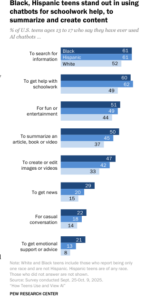
The study says that concerns about young people using chatbots for companionship have caught the attention of parents, advocates and lawmakers. However, beyond academics, 16% of teens say they have used chatbots to have casual conversations, and 12% say they’ve turned to AI for emotional support or advice. This finding has raised concern among mental-health researchers and experts.
The study shows how artificial intelligence has moved from novelty to normal in teenage life, with the long-term effects still uncertain. For schools, educators, health experts and families, the challenge is no longer managing exposure to AI, but managing reliance on it.
Also Read: AI as Therapist? Here’s Why That’s Not a Good Idea