Deus Ex Machina, is a Latin phrase that translates to “God from the machine”; a technique used in ancient Greek theatre where actors who played “Gods” were introduced on the stage using a machine. The phrase is widely used as a plot device to find solution to an impossible problem using an unexpected force.
Back in 1942, when the Atlantic Ocean was being ravaged by German U-boats, a 30-year-old Mathematics prodigy from Cambridge University managed to break the seemingly impossible Enigma communication code of the German forces, shortening the Second World War by at least two years, thus, saving millions of lives.
Less than a decade later, he presented an idea that continues to shape the stride of humanity towards excellence in artificial intelligence (AI), and probably, one day, the super ambitious Artificial General Intelligence (AGI).
The idea was – Can Machines think?
Meet Alan Mathison Turing, an English mathematician, computer scientist and cryptanalyst, who is widely regarded to have paved the way for artificial intelligence (AI) research for the next seven decades.
Turing, through his pioneering work in theoretical computer science and algorithm, spurned a global movement for scientific advances in AI.
Apart from conceptualizing Turing Machines, which are today known as modern computers, Turing delivered two excellent papers subsequently in 1948 and 1950, titled, “Intelligent Machinery” and “Computing Machinery and Intelligence”.
In his papers, he brilliantly laid down the concept of a “thinking machine and learning machine”, which could imitate the traits of a human mind related to learning, problem solving and decision solving.
He also presented the famous “imitation game test” to check whether a human is able to distinguish between a computer and another human, whilst communicating simultaneously to them. Today, we identify a reverse form of this test as CAPTCHA (Completely Automated Public Turing Test to tell Computers and Humans Apart).
What set Turing apart from his contemporaries was not just his zeal for advanced machine research, but his pragmatic approach against the then prevalent religious and social dogmas and irrational fear against science. Today, we see churches using LLMs to help the pastors with their sermons while Saudi Arabian government is using AI to manage the pilgrims at the holy Mecca.
By 2030, the AI industry is stipulated to reach the value of USD $1.3 trillion globally, spurned majorly by a barrage of Generative AI models that have both kindled great hope for humanity and caused distress among general populace regarding job cuts.
In this article, we will discuss the life and works of Turing, focussing on his contribution towards AI and how his thoughts and ideas continue to shape the next big thing in technology.
Alan Turing: Chance birth in London, childhood trauma and inclination towards atheism and materialism
Turing was born in Maida Vale, London on June 23, 1912 to Julius Turing and Ethel Turing. However, if luck had it, he would have born in British India, as his father Julius served as an administrative officer for the British Raj in India and his mother was chief engineer of Madras Railways in erstwhile Madras presidency. However, at the time of Ethel’s pregnancy, the Turing couple moved to London for Alan’s birth.
In his childhood, Turing studied at multiple schools until, at the age of 13, he enrolled at Sherborne boarding school in Dorset. It was here that Turing met his best friend Christopher Morcom, who is credited to have introduced him to cryptanalysis.
However, Morcom’s premature death, due to tuberculosis, caused great misery to Turing and as per scholars, brought him close to atheism and materialism. Even in his academic papers, Turing had not only challenged the prevalent religious fears against “machines”, he also drew parallels between the functionality between a human mind and machine, based on neuron network.
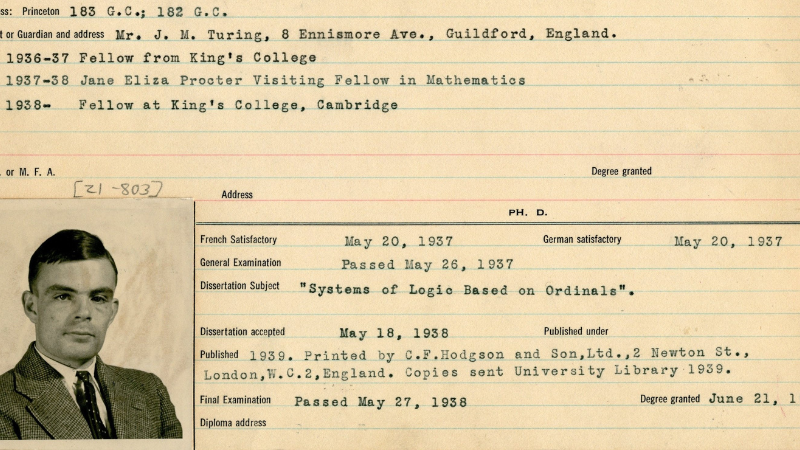
Later, Turing obtained a degree in mathematics from King’s College in Cambridge.
Turing’s Universal Computing Machine: Birth of Modern Computers
Post his graduation from King’s college, Turing was elected as a fellow at the mere age of 22. It was in 1936 that he published one of his most important works, titled ‘On Computable Numbers with an Application to the Entscheidungsproblem (Decision Problem).’
According to author B. Jack Copeland of “Essential Turing”, the paper published by Turing described the functioning of a digital computing machine, referred back then as “Turing Machines”. Today, those are called modern computers.
“Turing’s greatest contributions to the development of the modern computers was the idea of controlling the function of a computing machine by storing a programme of symbolically encoded instructions in the machine’s memory,” opined Copeland in his book “The Essential Turing.”
While Charles Babbage is credited as the inventor of computer, there was a remarkable difference between Babbage’s “Analytical Engine” and Turing’s “Universal Machine”. In Turing’s Machine, there was no fundamental distinction between programme and data as it used a mechanism that was deployed for both reading a program and executing it.
In his own words, Alan Turing in his remarkable paper titled “Intelligent Machinery” in 1948 says, “The importance of the universal machine is clear. We do not need to have an infinity of different machines doing different jobs. A single one will suffice. The engineering problem of producing various machines for various jobs is replaced by the office work of ‘programming’ the universal machine to do these jobs.”
Turing’s table of instructions for the universal machine (Turing Machine) are today called computer programmes.
Turing cracks unbreakable Enigma Code of Germans: World War 2 shortened by 2 years
Having developed an interest towards cryptanalysis at a young age, Turing joined the Government Code and Cypher School (GCCS) of the British government in 1938, at a time when Europe was being annexed by the Axis forces of Germany and Italy. His task was simple: lead a team of Britain’s best cryptanalysts and mathematicians to break the German Enigma machine, a key communication tool for the enemy forces.
For the next four years, Turing and his compatriots at Hut 8 of Bletchley Park, worked every day on gibberish messages emitted by Enigma and tried to break the code. In the process, Turing and his fellow mathematician Gordon Welchman developed “bombe”- an electromechanical device used to decipher code sent by Enigma using permutations and combinations.
Finally, it took years of Hut 8 team to break the Enigma code, intercept German messages and thereby provide crucial lead to allied forces to subsequent victory in World War 2.
In the words of mathematician and fellow cryptographer Irving John “Jack” Good, who worked at Hut 8 with Turing, “I won’t say that what Turing did made us win the war but I daresay we might have lost it without him.”
Machine Intelligence: Inception at Hut 8
In the four years that he served for British intelligence from 1938 to 1942, Turing not only worked on deciphering cryptic messages from the enemy, but also on machine intelligence and heuristic search- a problem solving method in AI where machine uses educated guesses rather than an exhaustive search.
According to author B Jack Copeland of The Essential Turing, it was at Hut 8, Bletchley Park, that Alan Turing coined the term “machine intelligence” (MI), having thought about it as early as 1941. In fact, according to Copeland, one of the earliest papers on AI was written by Turing at Hut 8, which was unfortunately lost and remains unpublished. Moreover, after the war was over, Turing and his colleagues were under oath under the official secrets act, to not reveal any of their studies.
“It has been speculated that this paper was about problem solving and machine learning from past experiences,” opines Copeland in The Essential Turing.
In fact, according to Copeland, Turing’s idea of AI was influenced by the device ‘Bombe’- whose central idea was solving a problem by means of a guided mechanical search through the space of possible solutions.
Today, we call it heuristic search in AI.
Turing asks the most critical question of our times: Can Machines Think?
Post the war, Turing continued his work on Automatic Computing Engines (ACE), creating the first ever design of a stored-program computer.
It was finally in 1950 that Turing published his ground breaking paper on AI titled, “Computing Machinery and Intelligence” in Mind magazine.
In the paper, Turing presented the “imitation game”- played by two humans and a machine, where one human will communicate with another as well as the machine and figure out which is which, The machine will attempt to masquerade itself as a human by mimicking their language, humour and mannerism in the communication, through learning process.
Turing, in his paper, laid down the possibility of machines learning from their past-experiences and mimicking the attributes of a person with training. His great foresight towards the advancements of computer sciences can be well understood by his observation on the doubts whether machines could think at all.
“The idea of a learning machine may appear paradoxical to some readers. How can the rules of operation of the machine change? They should describe completely how the machine will react whatever its history might be, whatever changes it might undergo. The rules are thus quite time-invariant…The reader may draw a parallel with the Constitution of the United States. An important feature of a learning machine is that its teacher will often be very largely ignorant of quite what is going on inside, although he may still be able to some extent to predict his pupil’s behavior,” said Turing in his paper Computing Machinery and Intelligence.
In his paper, Turing also objected to then prevalent theological point of view that the human mind is the supreme creation of God and no other, natural or artificial creation can supersede it.
“In attempting to construct such machines, we should not be irreverently usurping His (God’s) power of creating souls, any more than we are in the procreation of children; rather we are, in either case, instruments of His will, providing mansions for the soul that He creates,” said Turing in his paper Computing Machinery and Intelligence.
Conclusion: How far are we from Turing’s vision on Machines?
Alan Turing was a man of great foresight, who defied set norms and traditions, and made valuable contributions to his country and humanity in general. The fact that this genius was unjustly convicted of practising homosexuality and forced to undergo a “chemical treatment”, speaks volumes about the shabby manner in which his own government treated him. His death, a suspected case of suicide by poisoning, sparked a huge outcry in the intellectual circles.
Nevertheless, today, we remember Turing for his great contributions to computer science and machine learning. He spurned a generation of thinkers and scientists to research on the possibilities AI can achieve one day.
He has envisioned machines to excel in mimicking human behaviour in four major aspects-various games, learning and translation of languages, cryptography and mathematics, in his paper “Intelligent Machinery” in 1948.
While we might still be aeons away from achieving artificial general intelligence (AGI) in machines, what we can say for sure is that machines indeed can think, courtesy, the genius professor from London.
In Turing’s own words, “We can only see a short distance ahead, but we can see plenty there that needs to be done”.